AI for coaching firms: how to choose your first project
Choose a useful first AI project for your coaching firm. Explore six opportunities, compare ways to build, and work through a client follow-up example.
By Mollie Amkraut Mueller · 6 min read
A practical guide to the possibilities, the ways to build, and how to choose something useful for your firm.
An executive coach came to me knowing AI could help her business. Someone had suggested hiring developers. She wanted help deciding what was worth building first.
We ended up working on coaching feedback, client follow-up, and an assistant clients could use between sessions. Each addressed a different need. You can read the full case here.
If you run a coaching or leadership-development firm, you might recognize that starting point. There are plenty of examples to get excited about. The harder part is choosing one that fits your work.
A useful first AI project solves a specific, recurring problem, uses information you can appropriately provide, and has someone responsible for checking whether it works. Once you know what you want it to do, you can choose how to build it.
What could AI help with?
I find it useful to look across six areas:
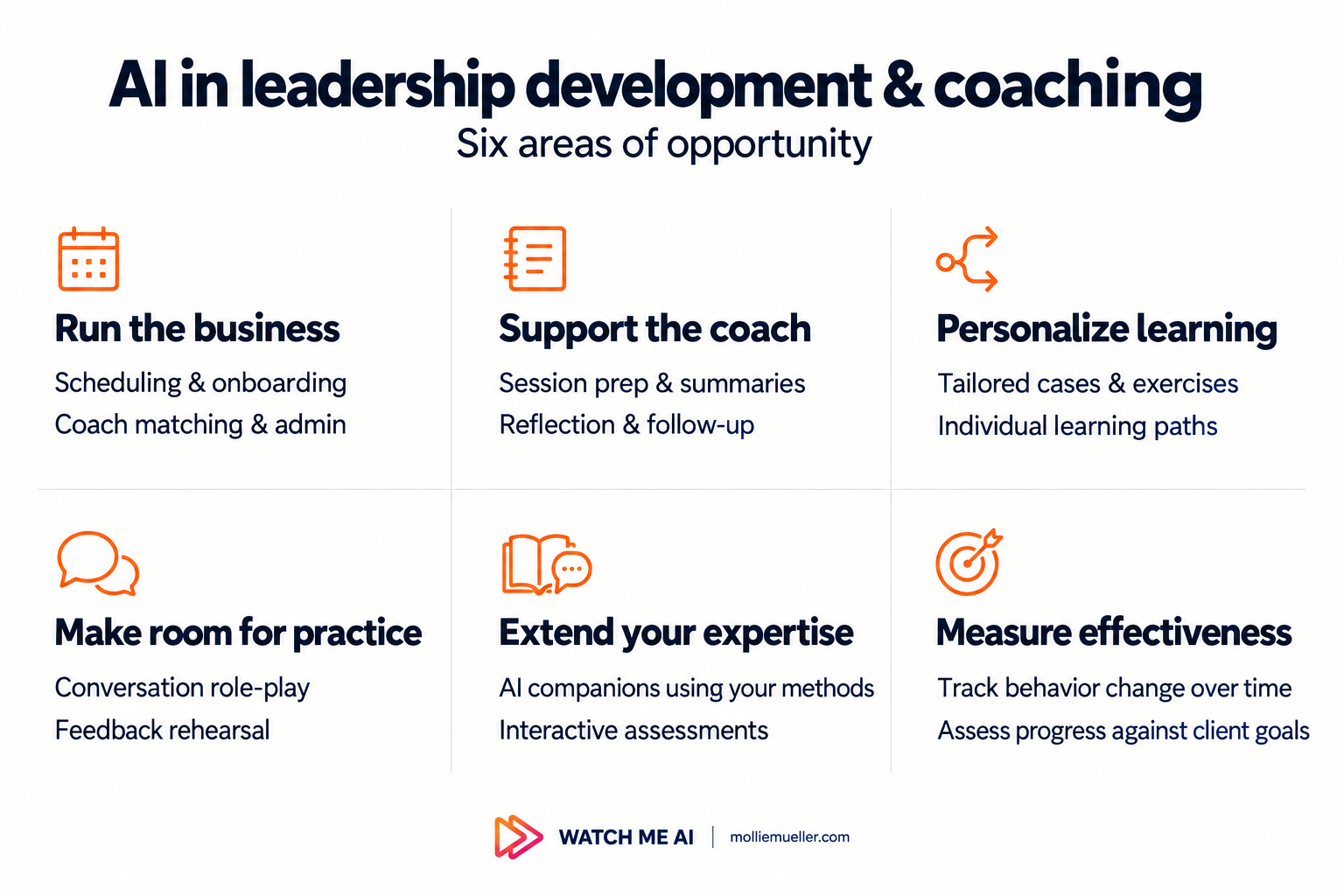
| Area | A possibility to explore |
|---|---|
| Run the business | Prepare onboarding materials or help match clients with coaches. |
| Support the coach | Prepare for sessions, draft follow-up, or support reflection on coaching practice. |
| Personalize learning | Adapt a case, exercise, or learning path to a participant's context. |
| Make room for practice | Let participants rehearse a difficult conversation and receive feedback. |
| Extend your expertise | Create an interactive assessment or an assistant that draws on your methods. |
| Measure effectiveness | Organize evidence of progress against agreed goals over time. |
These are possibilities to evaluate. The right choice depends on where your team or clients need help.
For measurement, be specific about what you can observe. Completing an exercise, reporting a change in behavior, and improving a business result are different things. AI might help organize the evidence; that doesn't establish what caused the change.
Start with a moment in the work
Take “support clients between sessions.” That could mean several different things.
A client leaves with useful commitments but receives inconsistent follow-up. A draft recap for the coach to review might help.
A participant needs an exercise from your program but can't find it. Clearer resource organization may solve the problem. An assistant that retrieves relevant material is another option if searching remains difficult.
A leader wants to rehearse giving difficult feedback before their next session. An interactive practice tool could be useful. It needs a scenario, guidance on what good practice looks like, and feedback worth acting on.
Those are three projects. Choosing between them starts with identifying the moment you want to improve.
For each idea, write down:
- Who needs help, and what happens today?
- How often does it happen, and what does it cost in time, effort, or missed value?
- What information would the tool need? Is it usable and appropriate to share with the chosen service?
- Who will review its work and maintain it?
- What would tell you it is worth continuing?
You should be able to explain the proposed project in one sentence: “We want to help this person do this task, and we'll judge it by this result.”
Choose a way to make it happen
Once the application is clear, there are several implementation routes. They can be combined.
| Route | When it may fit | What to consider |
|---|---|---|
| Use a tool you already have | A person needs help with a repeatable task, such as drafting or adapting material. | It still needs useful instructions, appropriate inputs, and review. |
| Configure a specialist platform | An existing coaching, learning, or practice product covers most of the need. | Check how well it fits your methods, permissions, reporting, and budget. |
| Connect existing tools | The work is clear, but information moves manually between systems. | Someone needs to handle failed steps and changes to the connected tools. |
| Build with a no-code or low-code platform | You need your own interface or workflow that a configurable builder can support. | Check access controls, platform limits, data handling, and ongoing ownership. |
| Commission custom software | Important requirements are difficult to meet with the other routes. | Budget for testing, support, and maintenance as well as the initial build. |
The amount of help you need is a separate choice. You might do the work yourself, work alongside someone who guides the setup, or have it implemented for you. Buying software still involves decisions about setup and adoption. Building a custom application still leaves someone responsible for it after launch.
A worked example: more consistent client follow-up
This is an illustrative scenario, not a reported client result.
Imagine a small firm where coaches write their own session recaps. Some go out quickly; others get delayed. The firm wants timely, useful follow-up while keeping each coach responsible for what reaches the client.
The first version: a coach uses an approved AI tool to turn their agreed session notes into a draft recap. The instructions ask for confirmed commitments and next steps, and tell the tool to flag missing details. The coach checks, edits, and sends it.
The material: a simple recap format, a few representative examples the firm has permission to use, and guidance on tone. The workflow can use notes; it doesn't depend on recording every session.
The test: try it on a small set of suitable sessions. Compare the time to produce a sendable recap with the current process, count factual corrections, and ask whether the coach and client find the result useful. Fast drafts that require extensive checking may not save time.
The owner: one person maintains the template and reviews problems, while each coach remains responsible for their client messages.
The next decision: if the drafts are useful and moving information is still cumbersome, consider connecting the tools. If the writing needs too much repair, improve the inputs and instructions before adding automation.
An interactive client companion would be a separate decision, with its own purpose and testing. For that type of project, the ICF AI Coaching Framework and Standards is a useful reference when evaluating privacy, testing, and the coaching relationship.
What should you do next?
Choose two or three possibilities from your own work and compare them. Look for a clear need, usable inputs, a manageable first version, and an owner. If none has those ingredients yet, clarify the need before commissioning a build.
If you want help making that choice, my AI Workflow Diagnostic is a 90-minute working session followed by written recommendations. We identify useful opportunities, compare tools and implementation options, and decide what is worth pursuing. Implementation can be scoped separately.
Explore AI support for coaching and leadership-development firms.