Should you be worried about AI's existential threat to humanity?
Four useful ways to think about the AI doomsday headlines: focus on the risks you can influence, use the AI you already have, and keep building your skills.
By Mollie Amkraut Mueller · · 8 min read
Two quick things before we get into it:
1) AI Arts & Crafts is this Wednesday
I'm hosting an AI Arts & Crafts event this Wednesday, September 16 at 12:30pm PT.
Come hang out, make lovely whimsical things, and forget about the doomsday news. Sign up for AI Arts & Crafts
2) I'm making coaching and leadership-development firms a bigger focus of my work
I've been working more with coaching and leadership-development firms, and I'm really enjoying it. I love this space and want to go deeper.
If you lead a coaching or leadership-development firm, I'd love to compare notes. What are you trying? Where are you stuck? What would actually help your team and clients?
Reply and let's find a time to talk, or introduce me to someone you think I should know.
I also wrote about where AI belongs in a coaching firm, and what should stay human.
The AI news is getting weird
Last week, one of the big AI stories was an Anthropic researcher quitting because he believes advanced AI could pose an existential threat to humanity.
As in: kill us all.
Not exactly a breezy headline to scroll past while drinking your coffee.
And it is far from the only one. Depending on what you read, AI is about to eliminate huge numbers of jobs, unlock extraordinary scientific breakthroughs, create catastrophic new security threats, usher in superintelligence, or potentially threaten humanity itself.
I follow this stuff pretty closely, and even I sometimes find myself wondering What am I actually supposed to DO with all of this?
I'm not going to weigh in on whether AI is going to kill us all (I recommend this relatively balanced analysis by the AI Daily Brief podcast for that). What I can help with is translating all of this into something a little more useful if you're trying to figure out what AI means for your work and your life right now.
Here are four ways I'm thinking about it.
1) Separate the AI we have from the AI people are warning about
When researchers talk about existential risk from AI, they generally aren't saying the version of ChatGPT sitting on your laptop today is about to destroy humanity.
They're worried about possible future systems that are dramatically more capable. Systems that could operate autonomously, pursue goals over long periods of time, potentially improve themselves, and exceed human capabilities across lots of domains.
That is a serious conversation, but it is a different conversation from: Should I let Claude analyze my customer research? Should my team use AI to draft proposals? Can I automate this annoying three-hour workflow?
"Should humanity build recursively self-improving superintelligence?" and "Should I use AI to prepare for my next meeting?" are not the same question.
We should stop treating them like they are.
2) Spend more of your attention on the risks you can actually do something about.
There are plenty of AI risks that aren't hypothetical.
- Someone on your team pasting sensitive information into a tool they shouldn't.
- AI confidently inventing an answer.
- Automating something that really needs human judgment.
- A scam becoming much more convincing.
- A company removing the human from an experience where the human relationship was actually the valuable part.
These aren't theoretical future problems. They're here. And the nice thing about them, if there is one, is that you can actually do something.
- You can decide what information goes into AI.
- You can decide which outputs get reviewed.
- You can decide where humans stay in charge.
- You can build better processes.
- You can teach people what good AI judgment looks like.
Personally, I want to spend a lot more of my worry budget there.
3) Remember how absurdly much runway we still have with the AI that already exists
Let's run a thought experiment.
Imagine AI stopped getting better tomorrow. No giant new leap in intelligence. No magical super-agent arriving next month. We are stuck with the capabilities we have now.
Would you be done?
I definitely wouldn't. I spend a ridiculous amount of time using AI, and I still regularly discover things I had no idea it could do. (This week I learned I can build a lego model of my house and have AI order all the pieces, amongst other things).
Today's models can already write software, analyze enormous amounts of information, generate images and video, conduct research, tutor us, automate workflows, role-play difficult conversations, build little applications, and help us think through messy problems.
And most people and most companies are using a tiny fraction of that.
Ethan Mollick made almost exactly this point:
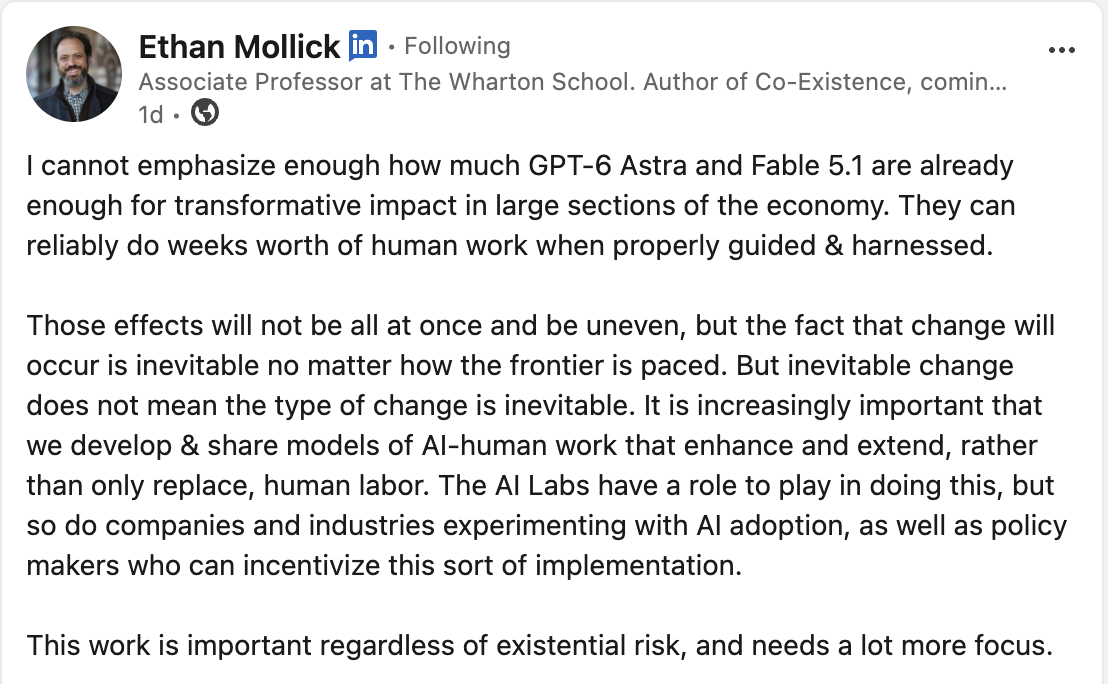
There's a strange disconnect in the AI conversation right now. At the frontier, people are debating how we get from extremely powerful AI to superintelligence. Meanwhile, most organizations are still trying to get from: "Some people on our team use ChatGPT sometimes" to "This technology has actually changed how we work."
Even if the frontier froze, our frontier has a long way to go.
4) Separate how you feel about AI from whether you learn how to use it
AI has become politically and culturally loaded. People have very legitimate concerns about safety, jobs, copyright, energy use, the power of the companies building these systems, regulation, and a whole list of other things.
There is also, in my opinion, an enormous amount of media incentive to make the conversation as inflammatory as possible. "AI is complicated and there are reasonable arguments on several sides" isn't exactly clickbait.
Here's my strong guidance: Your opinion about what should happen with AI at a societal level is separate from the question of whether you personally should understand how to use it.
- You can believe AI needs much stronger regulation and still become excellent at using it.
- You can be worried about its impact on jobs and still learn how it changes your own job.
- You can dislike the companies building it and still understand what the technology can do.
- You can think development should happen more slowly and still build the skills you're going to need if it doesn't.
Because refusing to learn how to use AI doesn't slow down AI development. It doesn't change OpenAI's strategy. It doesn't protect someone's job. Mostly, it means you have less agency in a world where AI is increasingly present. And that, to me, is the part that feels dangerous at an individual level.
You don't have to become an AI booster.
You don't have to think every development is good.
You certainly don't have to stop questioning where this is heading.
But I wouldn't confuse skepticism with opting out.
Learn the technology. Build your own point of view. Get good enough at using it that you have a seat at the table when decisions about it get made.
And if the question is okay, but how do I actually get better at this?
I have two places to start:
If you're basically starting from scratch: From AI overwhelm to AI mastery is my practical getting-started guide.
If you're already using AI and want to get much better at it: There is a 56% raise hiding in how you use AI covers the five habits I see separating casual AI use from actually getting leverage from it.
I don't know what happens with AI over the next ten years. But I don't think we need to solve the existential question before we can make smart choices today.
Take the big risks seriously. Pay even closer attention to the ones you can actually influence. Keep building your skills. And don't let the most terrifying headline of the week make the decisions for you.
Pick one AI. Give it a real problem. And start.