Where AI belongs in a coaching firm, and what should stay human
A practical boundary for AI in coaching: use it to support preparation, follow-up, practice, and operations while keeping the coaching relationship human-led.
By Mollie Amkraut Mueller · · 7 min read
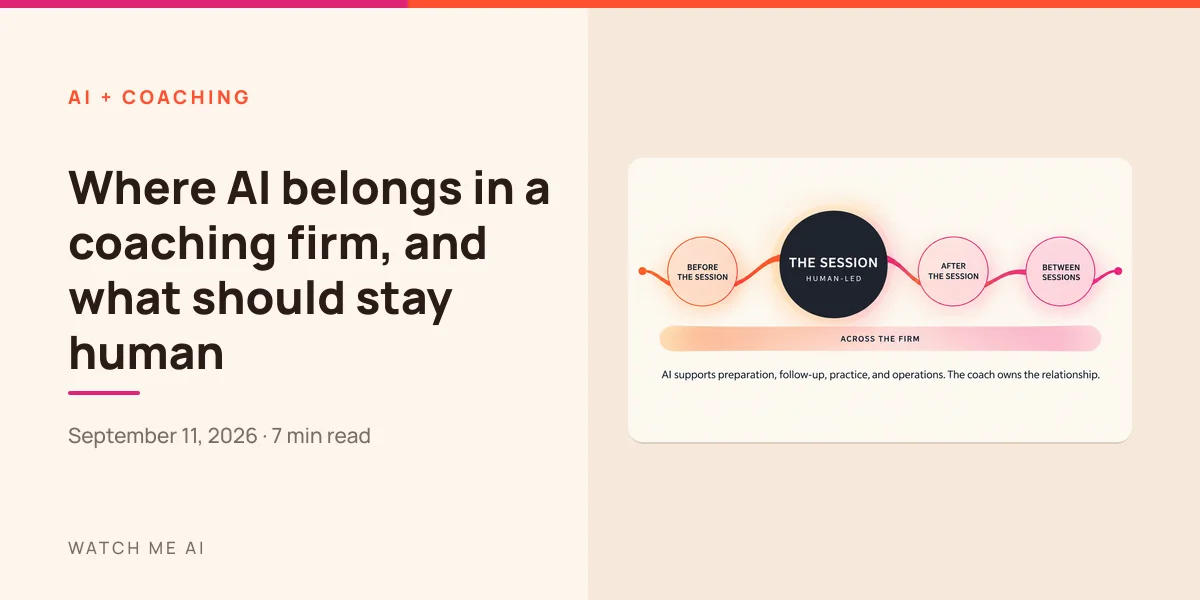
Most conversations about AI in coaching jump straight to the most dramatic question:
Will clients want to work with an AI coach?
I think there is a more useful place to start.
A coaching firm does a lot of work around the coaching conversation. Coaches prepare for sessions. They capture insights and commitments. They follow up. Clients try to apply what they learned. Firms onboard clients, match coaches, maintain their methodology, and look for evidence that the work is making a difference.
Those moments are full of information that needs to be found, organized, adapted, and moved from one place to another.
That is where AI can be extremely useful.
The coaching conversation is different. Trust, judgment, challenge, intuition, and accountability are central to the work. A coach notices the hesitation before an answer. They know when to push, when to wait, and when a client is asking for advice when what they really need is space to think.
My working rule is simple:
Put AI around the coaching relationship. Keep a human responsible for the relationship itself.

Before the session
A coach often begins a session by reconstructing context.
What happened last time? What did the client commit to? What themes have been recurring? Was there something the coach wanted to return to?
AI can organize that information into a short preparation brief. It can surface open commitments, recurring language, and questions worth considering.
The coach still decides what matters. The tool makes the context easier to access.
After the session
A valuable coaching conversation can quickly turn into a long transcript that nobody reads.
AI can draft a useful recap containing the insights the client named, the commitments they made, and the questions they want to keep considering. It can prepare a follow-up reminder in the coach's voice and leave it ready for review.
This creates more consistent support without asking coaches to spend another hour writing after every call.
The review step matters. The coach should remain responsible for what reaches the client.
A note on recording coaching sessions
Recording sessions can make this work much more powerful. A transcript captures the client's actual language, insights, commitments, and recurring themes. That creates useful material for follow-up, coach reflection, and between-session support.
I recommend recording when it fits the work, but only when it has been discussed clearly with the client before recording begins and everyone involved has agreed to it. The firm should explain why the session is being transcribed, how the transcript may be used, where it will be stored, and who will be able to access it.
I would never quietly introduce transcription into a coaching relationship. When recording is not appropriate, many useful workflows can still be built using coach notes, client-approved summaries, or other information the firm has permission to use.
Between sessions
Clients do a lot of the real work between coaching conversations.
They prepare for a difficult meeting. Try a new behavior. Lose confidence. Forget the exercise they meant to complete. Encounter the exact situation they discussed with their coach two weeks earlier.
AI can make the firm's resources and methods easier to use in those moments.
That might mean helping someone find the right exercise, reflect on an experience, rehearse a conversation, or revisit a commitment from their last session. It could also mean a private assistant grounded in the firm's methodology and the client's own coaching history.
The purpose is to help clients apply the coaching while the moment is still live.
Across the firm
There are also useful opportunities outside client delivery.
AI can help prepare onboarding materials, organize information for coach matching, adapt exercises to different leadership contexts, or identify patterns across permitted feedback.
It can help a firm turn a methodology that lives in documents and senior coaches' heads into something more usable across its work.
These systems still need ownership. Someone needs to decide what good looks like, review problems, maintain the source material, and determine what information can be used.
What should stay human
Some moments need a person to remain clearly responsible.
A human should own:
- The coaching relationship and the trust it depends on
- Interpretation of what is happening beneath a client's words
- High-stakes advice, challenge, and judgment
- Decisions about what a client needs
- Sensitive conversations or signs that someone needs additional support
- The boundary between confidential coaching and sponsor reporting
- Final responsibility for what is communicated to the client
Clients should also know when they are interacting with AI, what information it uses, who can see that information, and how to reach a person.
AI can prepare context, surface possibilities, and create a useful first draft. It can also misunderstand someone or produce an answer that sounds much more certain than it should. Human judgment remains part of the system.
What this looked like for one coaching firm
I recently worked with an executive coaching firm led by a principal coach and supported by a small bench of coaches.
The first pilot centered on the principal coach's live sessions, which clients had agreed could be recorded and transcribed. We began with a diagnostic, mapping the full workflow from recording and reflection through recap and between-session follow-up.
Then we tested three ideas:
- Coach reflection: A tool that reviews a transcript against the firm's coaching framework and gives the coach a structured way to reflect on the session.
- Client follow-up: Drafted recaps and weekly follow-ups in the coach's voice, ready for her to review before they reach the client.
- Between-session support: A private assistant grounded in the firm's methodology and each client's session history, with every client's information kept separate.
We tested each idea manually before automating it. That gave the coach time to judge the quality, refine the instructions, and decide where human review needed to remain.
Clients now have useful support between sessions, and the principal coach has a more consistent way to help them keep moving without creating more manual follow-up.
The firm also has a tested example of how its methodology can become a useful digital experience while its coaches remain in charge.
How to choose the boundary
Before introducing AI into a coaching workflow, I would ask five questions:
-
Which specific moment are we trying to improve?
“Use AI in our coaching” is too broad. “Help clients prepare for difficult conversations between sessions” is something you can design and test. -
Does the value come from access and consistency, or from human judgment?
AI is well suited to organizing context, retrieving material, and creating drafts. Moments built around trust, interpretation, and challenge need clear human ownership. -
What information would the tool need?
Determine what the firm has permission to use, where it will be stored, and how information from different clients will be separated. -
Who reviews and owns the work?
Every workflow needs someone responsible for quality, maintenance, and what happens when the tool gets something wrong. -
What would prove that the idea is useful?
Look for a practical signal: faster preparation, more consistent follow-up, greater use of program materials, or better client participation between sessions.
Start with the smallest version that can answer those questions. Test it by hand. Let coaches review the output. Automate it after the value and boundaries are clear.
The goal is a better coaching experience: coaches with more useful context, clients with more support, and firms able to extend their methods without weakening the human relationship that makes coaching work.
If you are choosing a first project, I wrote a practical guide for coaching firms. I also work directly with firms through an AI Workflow Diagnostic.